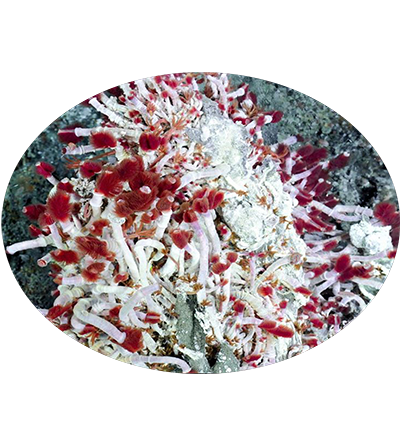
Ridgeia piscesae is a tube worm found in a variety of environments on the Juan de Fuca Ridge. Found in clusters up to several square meters in area, these Polychaete’s lack a digestive tract, instead taking up organic carbon from symbiotic, chemoautotrophic bacteria found in their specially-evolved trophosomes. These bacteria oxidize sulfur in order to create organic material. Initially thought to be several species of the Ridgeia genus on the Juan de Fuca Ridge, genetic comparison showed that only one species existed, with various morphologies. The two extreme morphologies are the so-called long-skinny and fat-short forms.
Animalia (Kingdom); Annelida (Phylum); Polychaeta (Class); Sedentaria (Subclass); Canalipalpata (Infraclass); Sabellida (Order); Siboglinidae (Family); Ridgeia (Genus); Ridgeia piscesae (Species)
Ridgeia piscesae Jones, 1985
1. Jones M L. On the Vestimentifera, new phylum: six new species, and other taxa, from hydrothermal vents and elsewhere[J]. Bull Biol Soc Wash, 1985, 6: 117. (Jones et al., 1985)
2. Southward E C, Tunnicliffe V, Black M. Revision of the species of Ridgeia from northeast Pacific hydrothermal vents, with a redescription of Ridgeia piscesae Jones (Pogonophora: Obturata= Vestimentifera)[J]. Canadian Journal of zoology, 1995, 73(2): 282-295. (Southward et al., 1995)
Shepherd's Vent, Axial Seamount, Juande Fuca Ridge. Hydrothermal vents of Juan de Fuca Ridgeand northern Gorda Ridge
| Species | Phylum | Common Name | Ecosystem | Depth | Habitat | NCBI Taxonomy ID |
|---|---|---|---|---|---|---|
| Ridgeia piscesae | Annelida | tube worms | Hydrothermal vent | 1,780-2,227 | the Juan de Fuca Ridge (47°57.00′ N, 129°5.82′ W) | 27915 |
| Genome Assembly | Genome Size | Assembly level | Released year | WGS accession | Submitter | BioProject | BUSCO completeness (%) | Scaffold/Contig N50 (kb) | GC content (%) | Repeat Rate (%) | Gene Number |
|---|---|---|---|---|---|---|---|---|---|---|---|
| R07B-5 | 658.2Mb | Contig | 2022 | JAODUO01 | Universite de Montreal | PRJNA786438 | 94.00 | 365.4 | 41 | - | 31,703 |
| Title | Journal | Pubmed ID |
|---|---|---|
| Third-Generation Sequencing Reveals the Adaptive Role of the Epigenome in Three Deep-Sea Polychaetes | Molecular Biology and Evolution | 37494294 |
| Gene ID | Description |
|---|---|
| KAK2181160.1 | - |
| KAK2181161.1 | 50S/60S RIBOSOMAL PROTEIN L16 |
| KAK2181162.1 | DEP DOMAIN CONTAINING PROTEIN 5 |
| KAK2181163.1 | DEP DOMAIN CONTAINING PROTEIN 5 |
| KAK2181164.1 | ATP-DEPENDENT RNA HELICASE RHLE-RELATED |
| KAK2181165.1 | - |
| KAK2181101.1 | UNCHARACTERIZED |
| KAK2181102.1 | L-THREONINE ALDOLASE-RELATED |
| KAK2181103.1 | L-THREONINE ALDOLASE-RELATED |
| KAK2181104.1 | THYMIDINE KINASE |
| KAK2181105.1 | UNCHARACTERIZED |
| KAK2181106.1 | - |
| KAK2181107.1 | - |
| KAK2181108.1 | EGF-LIKE DOMAIN-CONTAINING PROTEIN |
| KAK2181109.1 | - |
| KAK2181110.1 | - |
| KAK2181111.1 | REVERSE TRANSCRIPTASE DOMAIN-CONTAINING PROTEIN |
| KAK2181112.1 | REVERSE TRANSCRIPTASE DOMAIN-CONTAINING PROTEIN |
| KAK2181113.1 | TRANSCRIPTASE, PUTATIVE-RELATED-RELATED |
| KAK2181114.1 | PROTEIN CBG12054-RELATED |