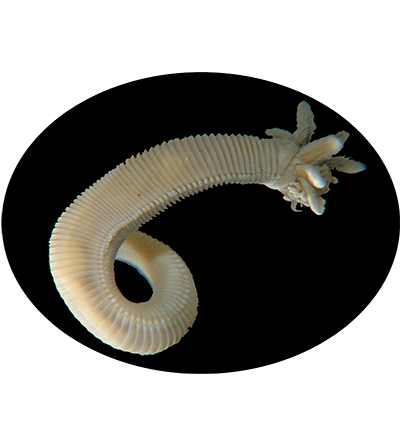
Paralvinella palmiformis, collected from hydrothermal vent on Endeavor Ridge, is about 3.5 cm long. It's a species of bristle-footed Annelids or fan-head worms in the family Alvinellidae. They usually build mucus tubes and feed with flattened, ciliated tentacles, plus obtain nutrition from episymbiotic bacteria living on their surface. Typically live with caudal end coiled around other worm tubes or attached to the surface of sulfide chimneys. They are a deposit feeder and cover themselves with mucus. Paralvinellids also are symbiotic with ectosymbiotic bacteria which live on the mucus.
Animalia (Kingdom); Annelida (Phylum); Polychaeta (Class); Sedentaria (Subclass); Canalipalpata (Infraclass); Terebellida (Order); Terebelliformia (Suborder); Alvinellidae (Family); Paralvinella (Genus); Paralvinella palmiformis (Species)
Paralvinella palmiformis Desbruyères & Laubier, 1986
1. Desbruyères D, Laubier L. Les Alvinellidae, une famille nouvelle d'annélides polychètes inféodées aux sources hydrothermales sous-marines: systématique, biologie et écologie[J]. Canadian Journal of Zoology, 1986, 64(10): 2227-2245. (Desbruyères et al., 1986)
2. Zhadan A E, Tsetlin A B, Safronova M A. Anatomy of some representatives from the family Alvinellidae (Polychaeta, Terebellida) from the Pacific hydrothermal habitats[J]. Зоологический журнал, 2000, 79(2): 159-160. (Zhadan et al., 2000)
From the Latin palmiformis, palm-shaped, an allusion to the shape of the gills which earned this species the nickname "palm worm" by early observers.
Juan de Fuca Ridge (47°57.00′ N, 129°5.82′ W), Northeast Pacific
| Species | Phylum | Common Name | Ecosystem | Depth | Habitat | NCBI Taxonomy ID |
|---|---|---|---|---|---|---|
| Paralvinella palmiformis | Annelida | palm worm | Cold seep/Hydrothermal vent | 2,196 | the Juan de Fuca Ridge (47°57.00′ N, 129°5.82′ W) | 53620 |
| Genome Assembly | Genome Size | Assembly level | Released year | WGS accession | Submitter | BioProject | BUSCO completeness (%) | Scaffold/Contig N50 (kb) | GC content (%) | Repeat Rate (%) | Gene Number |
|---|---|---|---|---|---|---|---|---|---|---|---|
| P08H-3 | 601Mb | Contig | 2022 | JAODUP01 | Universite de Montreal | PRJNA786438 | 96.00 | 557.2 | 36 | - | 24,682 |
| Title | Journal | Pubmed ID |
|---|---|---|
| Third-Generation Sequencing Reveals the Adaptive Role of the Epigenome in Three Deep-Sea Polychaetes | Molecular Biology and Evolution | 37494294 |
| Gene ID | Description |
|---|---|
| KAK2154719.1 | TRACE AMINE-ASSOCIATED RECEPTOR 19N-RELATED |
| KAK2154720.1 | TRACE AMINE-ASSOCIATED RECEPTOR 19N-RELATED |
| KAK2154721.1 | TRACE AMINE-ASSOCIATED RECEPTOR 19N-RELATED |
| KAK2154722.1 | POLYCYSTIC KIDNEY AND HEPATIC DISEASE 1 (AUTOSOMAL RECESSIVE)-LIKE 1 |
| KAK2154723.1 | HEAT SHOCK PROTEIN HSP-12.2-RELATED |
| KAK2154724.1 | - |
| KAK2154725.1 | ALKALINE PHOSPHATASE |
| KAK2154726.1 | CDNA SEQUENCE BC048562 |
| KAK2154727.1 | - |
| KAK2154728.1 | - |
| KAK2154729.1 | ETS |
| KAK2154730.1 | - |
| KAK2154731.1 | ETS |
| KAK2154732.1 | - |
| KAK2167661.1 | S-METHYL-5'-THIOADENOSINE PHOSPHORYLASE |
| KAK2167662.1 | TRANSLATIONAL ACTIVATOR GCN1-RELATED |
| KAK2167663.1 | MAP/MICROTUBULE AFFINITY-REGULATING KINASE |
| KAK2167664.1 | FERREDOXIN/ADRENODOXIN |
| KAK2167665.1 | PEPTIDYL-PROLYL CIS-TRANS ISOMERASE-RELATED |
| KAK2167666.1 | - |