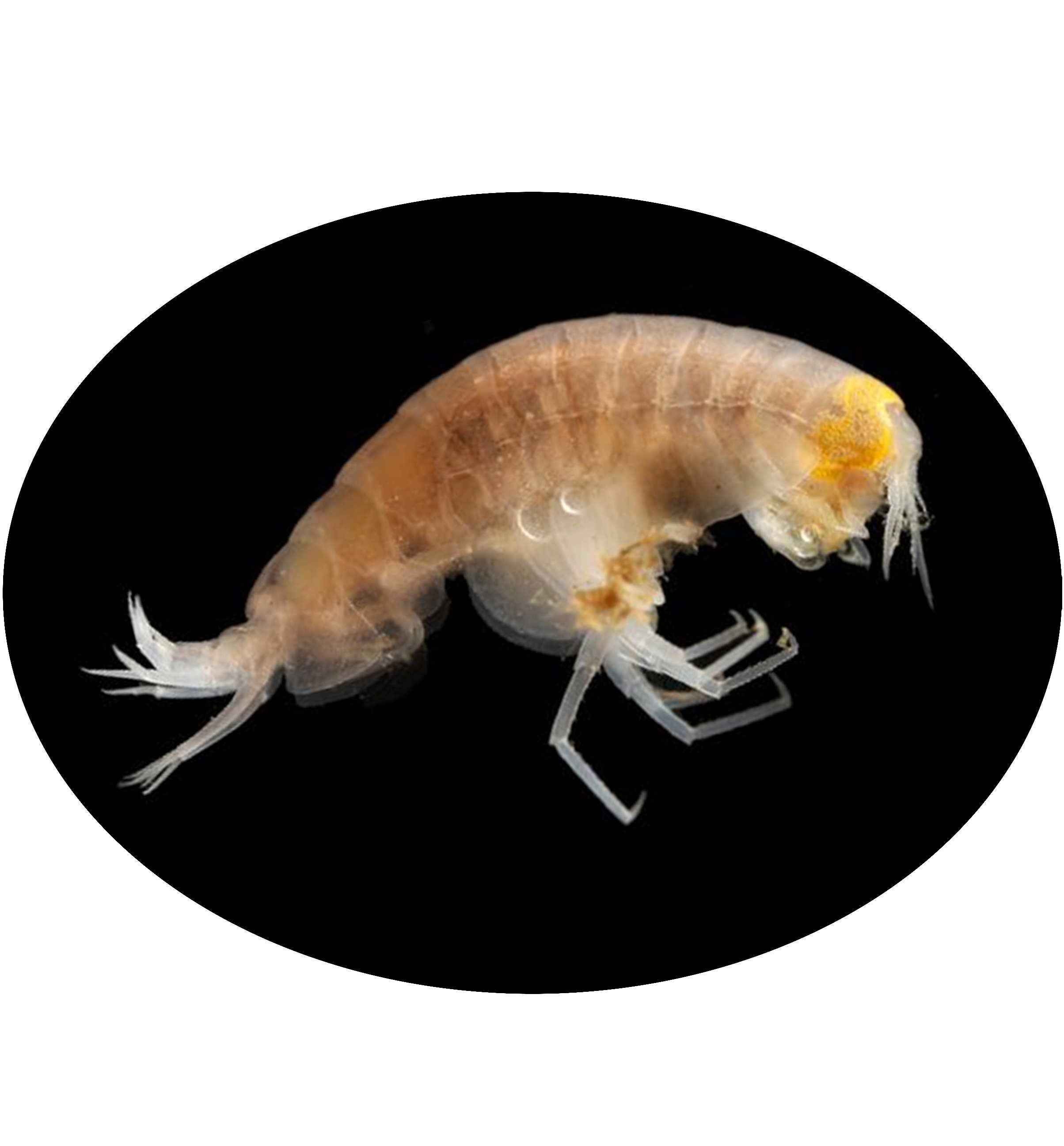
Hirondellea gigas is a species of amphipod crustacean found in the hadal zone of the Pacific Ocean, particularly in the Mariana Trench. It is adapted to extreme deep-sea environments, living at depths exceeding 10,000 meters where pressures are immense and temperatures are near freezing. This species feeds on organic matter that sinks to the ocean floor, playing a crucial role in the deep-sea ecosystem as a scavenger. Its unique adaptations, such as a lightweight exoskeleton and specialized enzymes, allow it to survive and thrive in one of the most extreme habitats on Earth.
Animalia (Kingdom); Arthropoda (Phylum); Crustacea (Subphylum); Multicrustacea (Superclass); Malacostraca (Class); Eumalacostraca (Subclass); Peracarida (Superorder); Amphipoda (Order); Amphilochidea (Suborder); Lysianassida (Infraorder); Lysianassidira (Parvorder); Lysianassoidea (Superfamily); Hirondelleidae (Family); Hirondellea (Genus); Hirondellea gigas (Species)
Tetronychia gigas Birstein & M. Vinogradov, 1955
1. Birstein J A, Vinogradov M E. Pelagicheskie gammaridy (Amphipoda, Gammaridea) Kurilo-Kamchatskoi Vpadiny[J]. Akademiya Nauk SSSR, Trudy Instituta Okeanologii, 1955, 12: 219-257. (Birstein et al., 1955)
Philippine Trench from Philippine Sea, Mariana Trench from North Pacific Ocean and Kuril-Kamchatka Trench
| Species | Phylum | Common Name | Ecosystem | Depth | Habitat | NCBI Taxonomy ID |
|---|---|---|---|---|---|---|
| Hirondellea gigas | Arthropoda | - | Deep sea | 6,800-11,000 | Mariana Trench in the northwestern Pacific Ocean | 1518452 |
| Genome Assembly | Genome Size | Assembly level | Released year | WGS accession | Submitter | BioProject | BUSCO completeness (%) | Scaffold/Contig N50 (kb) | GC content (%) | Repeat Rate (%) | Gene Number |
|---|---|---|---|---|---|---|---|---|---|---|---|
| - | 13.92Gb | Chromosome | 2025 | CNA0142381 | - | CNP0005374 | 89.34 | 458,700/466.1 | 38.8 | 72.75 | 27,881 |
| Title | Journal | Pubmed ID |
|---|---|---|
| The amphipod genome reveals population dynamics and adaptations to hadal environment | Cell | 40054448 |
| Gene ID | Description |
|---|---|
| Hgig_09177 | MITOCHONDRIAL IMPORT INNER MEMBRANE TRANSLOCASE SUBUNIT TIM44 |
| Hgig_09178 | TRANSPOSABLE ELEMENT TC3 TRANSPOSASE-LIKE PROTEIN |
| Hgig_09179 | - |
| Hgig_09180 | CARBAMOYLTRANSFERASE FAMILY MEMBER |
| Hgig_09181 | PROTEIN O-LINKED-MANNOSE BETA-1,2-N-ACETYLGLUCOSAMINYLTRANSFERASE 1 |
| Hgig_09182 | CARBAMOYLTRANSFERASE FAMILY MEMBER |
| Hgig_09183 | CARBAMOYLTRANSFERASE FAMILY MEMBER |
| Hgig_09184 | CARBAMOYLTRANSFERASE FAMILY MEMBER |
| Hgig_09185 | ALLANTOINASE |
| Hgig_09186 | ORNITHINE CARBAMOYLTRANSFERASE, MITOCHONDRIAL |
| Hgig_09187 | SHISA |
| Hgig_09188 | 39S RIBOSOMAL PROTEIN L14, MITOCHONDRIAL |
| Hgig_09189 | RNA BINDING PROTEIN |
| Hgig_09190 | POLY A -SPECIFIC RIBONUCLEASE/TARGET OF EGR1, MEMBER 1 |
| Hgig_09191 | MITOCHONDRIAL 2-OXODICARBOXYLATE CARRIER |
| Hgig_09192 | - |
| Hgig_09193 | EUKARYOTIC TRANSLATION INITIATION FACTOR 4E-BINDING PROTEIN |
| Hgig_09194 | CCR4-NOT TRANSCRIPTION COMPLEX SUBUNIT 10 |
| Hgig_09195 | CHROMODOMAIN-HELICASE-DNA-BINDING PROTEIN 3-RELATED-RELATED |
| Hgig_09196 | ADP RIBOSYLATION FACTOR-RELATED |